Wednesday, February 27, 2013

Content Highlight - Polar bear (Ursus maritimus)


Did you know that today (February 27) is The International Polar Bear Day?

Photo of polar bear by Alan Wilson from EOL


Polar bear (Ursus maritimus) grows up to 2.6 m and can be simply recognized by a thick white fur. Together with Kodiak bear, the polar bear is the largest land carnivore (order Carnivora). Polar bears are widespread in the whole Arctic region. They prefer floating pack ice which they use for traveling. Thus, their geographic range usually reaches the southern area of floating ice.


These mammals usually live solitarily and have a great smell. This sense is useful when searching for prey. Polar bears mainly feed different species of seals but they also feed small whales, birds and walruses. Main hunting technique is waiting near a hole in the ice on prey. If necessary, the bears can survive for a long time with their fat reserves, only.

Listen to the voice of the polar bear on Europeana

While males of polar bears grow up to mentioned 2.6 meters, females are roughly half that size. They usually give birth to one to three cubs from November to January. Female takes care for the cubs for 2.5 years. It is a well-known fact that these bears can live up to thirty years. Polar bear population is currently between 20 to 25 thousand individuals.

Polar bear and its prey from BHL

If you are interested in polar bears and other arctic animals, see Northwest Passage, NortheastPassage and Conquering of North pole in BLE – Expeditions. Stay tuned!

Thursday, February 14, 2013

Content Highlight – Fugu/Blowfish (Tetraodon/Arothron)

If you like Japanese food, be careful when you try fugu. Some organs of this fish are very poisonous. The chef, who wants to prepare the fugu, must go through a three-year training to recieve a special license.


Photo of Arothron nigropunctatus by Dennis Polack from EOL

Blowfish are a medium-sized fish (up to 60 cm) with a beak-like mouth. They have a rounded body without scales, or with tiny spikes, and no ventral fin. The Japanese name "Fugu" translates into "river pig". Blowfish can suck water into a special stomach chamber and expand their body, similarly to a porcupinefish. The blowfish is the first fish whose genome has been completely read.


Tetraodon from BHL

The blowfish is considered a delicacy in Japan, although it is deadly dangerous. The tissues of this fish (especially reproductive organs, liver, intestines and skin) of some blowfish contain the poison of tetrodotoxin. First signs of poisoning appear in 30 minutes after ingestion. Numbness of the tongue, lips and fingertips come first. Next are headaches, fatigue, lassitude, speech impediment and difficulty to breathe. Gradual paralysis of breathing muscles follows, with a coma and death within 24 hours after eating a blowfish.


Results for Arothron on Europeana 
You can find more about blowfish on BLE Poisonous Nature. Stay tuned!

Thursday, February 7, 2013

Common Laburnum (Laburnum anagyroides)

Be aware that some plants in parks and gardens could be poisonous, especially for children. One of them is Common Laburnum. And did you know that during First World War, experiments were conducted aimed at using laburnum to replace tobacco, because the principal psychoactive chemical is cytosine, which has similar effects to nicotine?

Laburnum anagyroides, this image is under CC-BY-SA of University of Vienna, Institute for Botany - Herbarium WU in Europeana 


Laburnum is a robust shrub or small tree with smooth gray bark, reaching heights of up to seven meters. It blooms from April through May with profuse cascades of labiates yellow racemes. Pods are bean-like, colored brownish-gray. This angiosperm is also known as golden rain or golden chain. It originated in southern and southwestern Europe, but is frequently planted in parks and gardens as an ornamental shrub. Its hardy character also led to it frequently being planted around schools, and this was a frequent source of mass poisonings in children.

Laburnum anagyroides from BHL

Laburnum contains poisonous cytosyne, which is present primarily in the flowers, seeds and roots. Most poisonings occur in children, from playing with pods and seeds. A fatal dose for children is three to four pods, or twelve to fifteen seeds of laburnum. Initial symptoms of poisoning appear thirty minutes to an hour after ingestion, and include burning mouth, nausea and vomiting. Subsequent symptoms are intense stomach and intestinal cramps, sweating, headaches and muscle spasms, up through circulatory failure. Fatal poisonings are manifested as whole-body paralysis with death from lung paralysis in one to several hours.

Photo of Laburnum anagyroides by Hermann Falkner from EOL

See more poisonous plants on Poisonous Nature. Stay tuned to us.

Thursday, January 31, 2013

California Fungi/ Funeral Bell (Galerina marginata)


Do you like picking wild mushrooms? If so, be careful not to pick a Funeral Bell, because they are almost as dangerous as the much better-known death caps (Amanita phalloides), and even contain similar toxins.

Galerina marginata (fig. 1) this image is under CC-BY-NC-SA of Danish Mycological Society in Europeana

Galerinas are small mushrooms with broad, almost flat cap, bearing a small central brown bump. Galerinas grow primarily in spruce and pine forests, on rotting logs and stumps. They can be found on every continent of the northern hemisphere, and have even been found in Australia. Galerinas may be mistaken for well-liked and sought-after sheathed woodtufts, which are noted for their sweet fruity smell and occurrence on deciduous wood.

Photo of Galerina marginata from EOL

This small mushroom causes very serious poisonings. The toxins it contains are not broken down by heat, and remain poisonous even after being thoroughly cooked. A fatal dose for an adult is around 10-15 mushrooms - considering how small and thin they are, that is not very much material. Poisonings have an effect similar to that of the death cap - damage to liver and kidneys. The smaller number of poisonings, compared to the death cap, is somewhat due to its relative scarcity, but largely because most pickers regard all small mushrooms growing from stumps as inedible 'toadstools'.

Galerina marginata (fig. 103) from BHL

Want to see other poisonous fungi? Nothing is easier than looking at our Poisonous Nature topic on BLE.

Wednesday, January 23, 2013

Content Highlights - Sydney Funnel Web Spider (Atrax robustus)


Do spiders creep you out? If so, Atrax robustus could be a nightmare for you! This guy often lives in courtyards in Sydney's suburbs. And did you know that in some parts of Australia, Atrax spiders are considered more dangerous than poisonous snakes?

Atrax robustus - EOL

Atrax robustus is the most feared spider in Australia. It has a relatively small black-brown body. Females can be up to 7 cm long, while males are somewhat smaller at 5.5 cm. Its chelicerae (fangs) can be up to 5 mm long. It lives under logs and rocks in forests, parks and urban gardens in southeast Australia. Like other members of the infraorder Mygalomorphae, it builds funnel-shaped webs, made of spider silk. It is very aggressive and often attacks anything coming close to its nest. When threatened, it rears up on its hind legs and rocks its body. It attacks by jumping onto its victim and delivering a very painful bite.

Atrax venenatus - BHL

Atrax poison is neurotoxic and extremely strong; initial symptoms appear within ten minutes, and death can occur within a few hours. Besides burning pain, the bitten area swells. Lymph nodes become infected, salivation increases, along with sweating, tearing and urination, sometimes accompanied by nausea, diarrhea, vomiting and ague. Further symptoms include stomach cramps and a tightening sensation across the chest. It is interesting that poison from this spider is extremely dangerous to humans and other primates, while other animals are essentially immune to it.

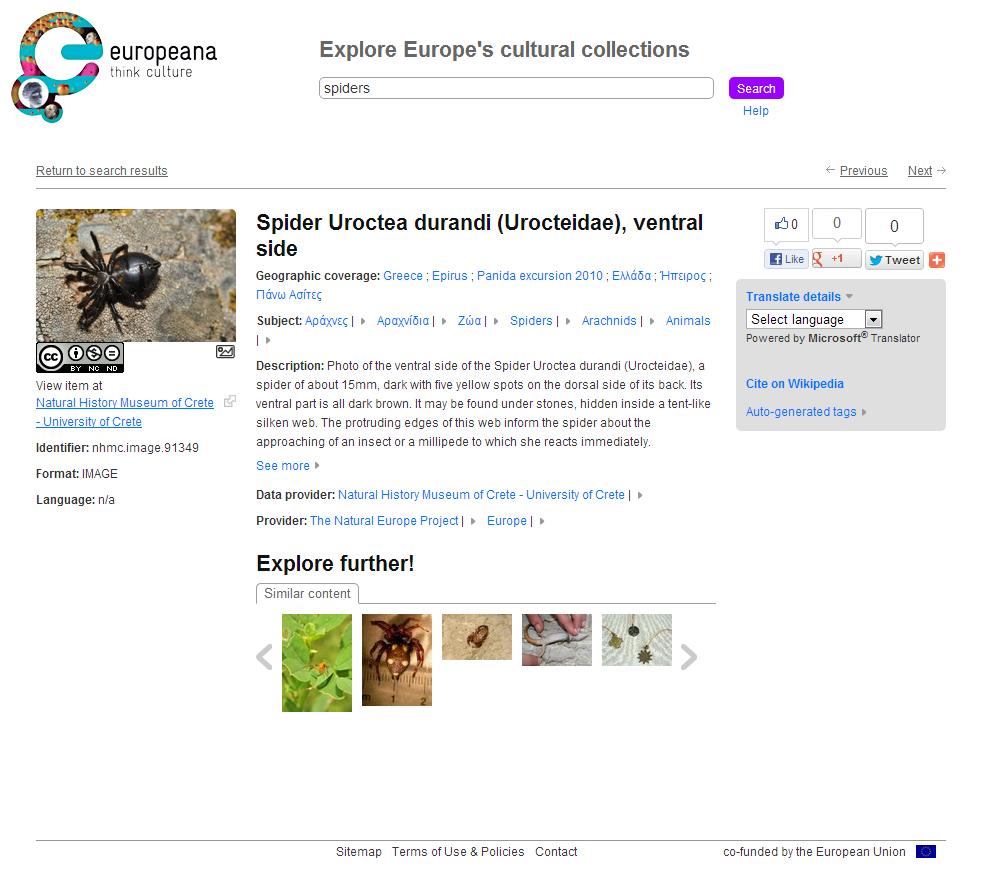
Rich collection of spiders is also in Europeana

Do you like these venomous creatures? If so, you can see more of them in our series poisonous nature on BLE. Stay tuned to us.

Thursday, January 17, 2013

Flowing Smoothly into Europeana: the OpenUp! Technical Workflow


Do you know how the content from the collections actually reach the Eropeana portal and could be then demonstrated for example as our content highlight? Today we would like to explain to you, the OpenUp! technical architecture and content workflow.

One of the main tasks in the OpenUp! project is to harvest the standardised metadata of multimedia objects of natural history data providers and to transform this data into the Europeana schema. The transformed data is aggregated in the OpenUp! Metadata Database of the Europeana Natural History Aggregator established by the OpenUp! project and subsequently handed over to Europeana (Berendsohn & Günstsch 2012).

Data or metadata?

We need to explain our view on the term, ‘data’ and ‘metadata’ in the OpenUp! project. For example: Natural History domain data is included in the metadata for multimedia objects (physical object information). Metadata usually refers to the technical data of a multimedia object, e.g. aperture, camera type, etc. However, Europeana calls domain data (= records) related to the physical object by the term ‘metadata’, and features this associated metadata along with the digital object. This metadata is distributed under CC zero licence in Europeana – under the full control of the provider. Only a minimum set of mandatory concepts is required for Europeana (fig 1).
Fig.1) Green squares display the metadata provided to Europeana under CC0 (no copyright). The red square shows the data which is licensed under the CC framework including the thumbnail (preview) and the source object (indicated by link View). The icence used is indicated by icon. (Creative Commons licences)

The OpenUp! architecture is divided in  two integral parts. The first part addresses the data provision, including the set-up of the BioCASe Provider software and the mapping to the domain standard ABCD (Access to Biological Collections Data) and its extension EFG (Extension for Geosciences). The second part is the Europeana Natural History Aggregator which builds the OpenUp! Metadata Database, assures the transformation of the domain standard ABCD (EFG) to the Europeana standard ESE (Europeana Semantic Elements) and enables the harvest by Europeana.

The overall OpenUp! to Europeana (technical aggregation) workflow consists of seven major steps that are visualized in the following graphic (p. 19) and described  bellow.

Workflow Description:

Content provider and coordination (Steps 1–3):
The technical set-up for data provision in OpenUp!  can be used   /is used to provide data to the GBIF network.

Step1: Domain standard ABCD and its extension EFG

As the first step the multimedia object associated metadata of the provider (collection data) is mapped to the ABCD domain standard (zoology and botany) and its extension EFG (palaeontology, mineralogy and anthropology). The mapping to the ABCD standard is carried out using the BioCASe Provider Software. Finally the BioCASe Provider Software serves as a web-interface for providing the data for harvesting.

Step2 (optional): Data quality check

Before harvest (Step 4), providers can check their data with the Data Quality Toolkit, which provides a service for automated testing of their data quality, e.g. conformity of the data or check of scientific names against reference services. After testing the data, providers can apply necessary changes in their source data or in mapping between the database and the BioCase Software tool.

Step3: Compliance check and monitoring of data provision

Providers can check their mapping and the correctness of the used concepts in the BioCASe Monitor Service by attaching their data source access point URL to this URL. Sample values for each concept are displayed and concept values are counted on demand, which helps detecting inconsistencies or incorrect use of concepts according to the ABCD documentation.

Furthermore, the BioCASe Monitor provides a compliance check for Europeana and displays error messages if mandatory concepts for the ABCD to ESE transformation are missing. The providers should assure they have a functional data source and correct mapping before requesting a test-harvest. The OpenUp! Helpdesk provides documentation and technical assistance for the setup of the BPS and the ABCD (EFG) mapping, and assists the providers in troubleshooting, in close collaboration with the BioCASe Helpdesk and the GBIF team.

The progress in content provision is monitored in the BioCASe Monitor Service by the coordination teams of the content providing Work Packages 4 & 5 in OpenUp!.

Step4: (Test) Harvest

Once the mapping is quality checked by the coordination teams of the content providing Work packages and the OpenUp! Helpdesk, a test harvest with the GBIF Harvester, the HIT (Harvesting and Indexed Toolkit), is initiated. Test results and valid content is communicated back to the provider in order to allow for further adjustments. Technical problems encountered during test-harvest are fixed in collaboration with AIT, the OpenUp! Helpdesk and the BioCASe Helpdesk team. A harvest of the entire data source is initiated after successful completion of the test-harvest and confirmation by the provider.

The data provider can check the visualization of their content in Europeana by the Europeana Content Checker tool. This tool is also used by the WP coordination for a final quality check and to detect issues in the display of data/content in Europeana. Encountered problems in display of the data in the Europeana portal not related to the data provided are communicated back to the Europeana.
Fig.2) OpenUp! technical architecture with main steps indicated

Step5: HIT Harvest

The HIT Harvester stores bulks of ABCD (EFG) records into the central aggregator OpenUp! metadata database. This database stores only the metadata, including the URLs of the multimedia data.

Step6: ABCD (EFG) transformation to ESE

The metadata from the ABCD (EFG) standard used by the natural history domain are transformed into ESE, which is used as a cross-domain metadata standard in Europeana. The transformation is carried out using Pentaho Data Integration (Penthaho Kettle). The mapping tool picks up the metadata, transforms them and stores them in a metadata database.

Step7: OAI-PMH and Europeana harvest

The metadata are periodically harvested by Europeana via a single OAI-PMH (The Open Archives Initiative Protocol for Metadata Harvesting) access point at the metadata database. Previews of multimedia objects for presentation and queries in the Europeana portal are generated by Europeana from full object URLs given in metadata. This is the final step in the workflow when providing data in the flat ESE standard.

This is the actual implemented technical workflow. We will publish updated workflow including the semantic enrichment and EDM transformation in next newsletters and on our Blog. Stay tuned!

References:

Friday, January 4, 2013

Content highlight: Christmas/Common holly - Ilex aquifolium


Christmas Holidays are behind us, but why not extend a little bit of this wonderful feast atmosphere by presenting our new content highlight - holly? Did you know that tradition states that a sprig of holly placed inside the entry-way doorframe guards the home against lightning strikes? Or that holly was also revered by Celts, Romans and Germans as a symbol of eternal life?

Ilex aquifolium - image is on EOL portal under CC-BY-SA, from Sten Porse.

Christmas holly is one of the symbols of Christmas. Christian folklore states that holly thorns represent Christ's crown of thorns, and the red berries his blood. Holly captures our attention with its prickly, waxy leaves and later, its bright red berries. Its home is western, central and southern Europe, northern Africa, Asia Minor and northern Iran. It is often planted as a decorative shrub in parks. From May through June it blooms with tiny white flowers. In the fall, these give rise to small red berries. The plant contains the alkaloid theobromine, as well as other substances like saponins and terpenoids.

Common Holly - Ilex aquifolium, illustration is on BHL portal.

Cases of poisoning occur mainly in children, from consuming the bright red berries. Symptoms are nausea, strong diarrhea and sleepiness. Initial symptoms can occur in children with the consumption of as few as two berries. A fatal dose for an adult is considered to be 20-30 berries. However, newer research suggests that even larger doses cause only vomiting and diarrhea.
Ilex aquifolium - image is on Europeana portal under CC-BY-SA, from Biologiezentrum der Oberoesterreichischen Landesmuseen 

We wish you a Happy New Year in 2013, and promise you to bring many more exiting stories from Natural History. Stay tuned! You can find more about Holly on BLE - Poisonous Nature!